A Gathering of Gardeners
Nice people. Fun garden talk. Plant sharing. And a lot of laughs.
Meeting Schedule
Upcoming Meeting, December 1st:
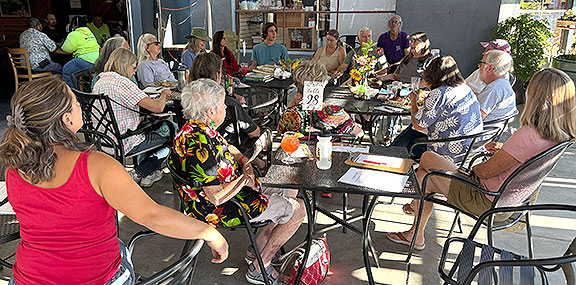
Cottage Grove Gardeners’ Club meetings take place Mondays (5:30 p.m.) at Coast Fork Brewing (106 South Sixth street in Cottage Grove). Beginner to expert…everyone is welcome. Join us!
Who Doesn't Absolutely Love a Chipmunk?
Our illustrious leader, evidently. At the last meeting, in reference to the cuter-than-cute little darlings, she said: “Those dirty little rat @&*#!”
Explanation requested…(the public has a right to know).
Bees!
Garden Club co-founder and Bee Club president, Norm Jarvis was the featured speaker at the most recent Garden Club meeting, and provided a fascinating presentation about the life of bees, and their relationship with our gardens.
“People might be wondering why this is a suitable topic for Garden Club,” Norm said as he began his presentation. “It’s a question of mutualism: bees need flowers, and flowers need bees.”
Norm, who tends beehives at his home, said that if it wasn’t for bees, the amount and varieties of fruits and vegetables we enjoy would be dramatically (and negatively) affected. “Every year, millions of honey bees get trucked into Oregon fields; specifically to pollinate crops and fruits. Bees represent a large-scale agricultural pollination program.”
And then things got really interesting.
DID YOU KNOW?
Modern beehives are built to mimic a hollow tree, which is where honey bees built their hives throughout history. Hollow trees have air flow at the top and bottom, as do the beehives you see in the fields throughout the county, each of which houses 20,000 to 80,000 bees.
Up to 80,000 in a single hive, yes…but there are only three types of honey bees:
1. The Queen: she only has one job: lay 1,000 to 2,000 eggs a day, thus repopulating the hive.
2. Drones: they also have a single job: to mate with the queen. (Not a dream job, because they’re all kicked out of the hive at the end of every summer, and die.)
3. A huge amount of worker bees (all female).
These worker bees are where the magic is to be found. They do the vast majority of work in the hive, and they perform different tasks: they don’t just spend their days flitting from flower to flower.
There are cleaner worker bees, which keep the hive in proper order. Comb-builder ones that build the cells which will house the next generation of workers. And there are nurse-tender bees to take care of the newborns.
During the hottest days of summer, worker bees can become HVAC Specialists. They move their wings in unison by their thousands to create air flow within the hive, thus cooling it. (Bees like their hive to be about 90-97 degrees Fahrenheit (at least in the brood area), and if it’s cold in winter, they can generate enough heat with their wing muscles to maintain nearly that temperature in a tight bee cluster (similar to penguins).
Worker bees become chefs (of a sort) and make honey by mixing nectar with saliva from their mouths. (Is honey basically made up of flower pollen and bee spit?)
There are also bees who do guard duty. They keep the hive safe by inspecting every visitor to the hive. The guards touch antennae with everyone that tries to enter, and there’s big trouble if the visitor isn’t recognized as a fellow-hive dweller.
And when needed, worker bees turn into mortuary bees, and discard the hive’s dead (worker bees only live between four to six weeks. The queen lives about five years.)
Drones, as we’ve learned, get thrown out of the hive at the end of summer. But until that dreadful day happens, there are drone feeder bees to take care of these louche layabouts. And the Queen is surrounded by Attendants, which groom her.
There are also pollen packers that pack the honeycomb’s cells with pollen. And finally…drum roll, please…there are bees that collect nectar, which will be used to make the honey that honey bees are so famous for. (They can fly up to three miles to find flowers.)
THERE’S MORE!
Honey bees represent only one species of bees. Oregon has 600 to 700 native bee types. Most do not build colonies like honey bees do.
Bees aren’t the only species that pollinate flowers: moths, butterflies, even bats do it.
Some bees are specialists, and are the only ones that can make their way into specific flowers. And many flowers use pigments that reflect ultra-violet light (which we can’t see, but bees can) to show landing strips on their petals, which act as “nectar guides” to attract the bees and indicate where they should land and be able to go directly to the nectar.
If a bee discovers a specifically good patch of flowers, it will return to the hive and perform a waggle dance for the other bees. In this way, it communicates how large the flower patch is, how far away it is from the hive, and the direction other bees should take to find it.
And if you were wondering if bees sleep? They do, but in 10 minute segments. They’re also quite active through the night.
Gardener Profile: Norm Jarvis
My favorite vegetable to grow (and why):
Sun Sugar cherry tomatoes! (and some similar varieties like Sun Gold) I love that they are easy to grow, prolific, produce throughout the season, and I can pick them off the vine while I am working in the garden, and just pop them in my mouth.
My favorite fruit to grow (and why):
Grapes (especially Interlaken and Canadice) Grapes of most varieties grow so well in our area and require very little care. Heavy pruning in the winter enables rapid growth of new vines that provide wonderful shade when trained over a pergola and allows easy access to the ripe clusters from below. I really like that they are so abundant and I can harvest the sweet fruit for several weeks in the fall.
Favorite decorative plant (shrub, tree, vine, etc.).
My favorite ornamental bush is the Mexican Orange Blossum (Choisya ternate). I have several planted in my yard and they typically bloom in the spring and again in the late fall, producing a blanket of very sweet-smelling blossoms on a background of dark evergreen foliage. The bushes are a big favorite with my bees, especially in the fall when almost nothing else is in bloom.
Something gardening has taught me:
Patience when the birds eat my plants. When they plant seeds where I didn’t want them and when my starts don’t grow to not stress about it, just try again.
My best gardening tip for beginners:
Be patient! Plants operate on their own (non-human) time scale. Many times, I have planted seeds, or full plants and seen them fail to sprout or look very ill. Just as my wife is telling me “Throw them out!”, they bounce back and show signs of life. I have often had plants (like Lazarus) rise from the dead, and go on to be treasured plants.
The success I’m most proud of:
The garlic that I plant yearly on Oct 1st. This year’s harvest was over 100 bulbs
My funniest (or not) failure:
I went to a cover crop (“green manure”) planting class at Territorial seed shortly after we moved to Oregon. I was excited to learn about a crop that would help break up the rock-hard clay soil that I had in all my garden beds. So, I got a big bag of Daikon radish seed and cast it everywhere. All was good! It grew prolifically and I’m sure that tap roots were popping out of the ground (upside-down) in China. But…. I didn’t listen carefully enough when the class instructor told us to not allow it to flower. I blissfully looked at all the pretty blossoms (and my bees on them) and didn’t think about the after-effects. The next year I had Daikon EVERYWHERE! I am still finding it popping up around my yard.
A despised garden pest:
Next to deer – snails and slugs. They are nasty little buggers that sneak into my garden at night and chomp away on my best plants
My favorite gardening tool:
My Kubota tractor! I am well past my youthful days of hauling 20 yards of compost or garden soil around in a wheelbarrow. I can’t get everyplace in my garden with the tractor, but it does the ‘heavy lifting’ when I need to move stuff across the yard.
How long have you been gardening in Oregon?
I started gardening in Oregon in 2018, as soon as we moved her from Colorado. (I was a frustrated wanna-be gardener in CO.)
What do you enjoy the most about Garden Club?
I love talking with folks who enjoy gardening as much as I do, and learning from each other. Everyone brings unique knowledge and experience to the group, and is willing to share. It also builds community. (Doing it over a nice, cold beer, is an extra bonus!)